

No products in the cart.
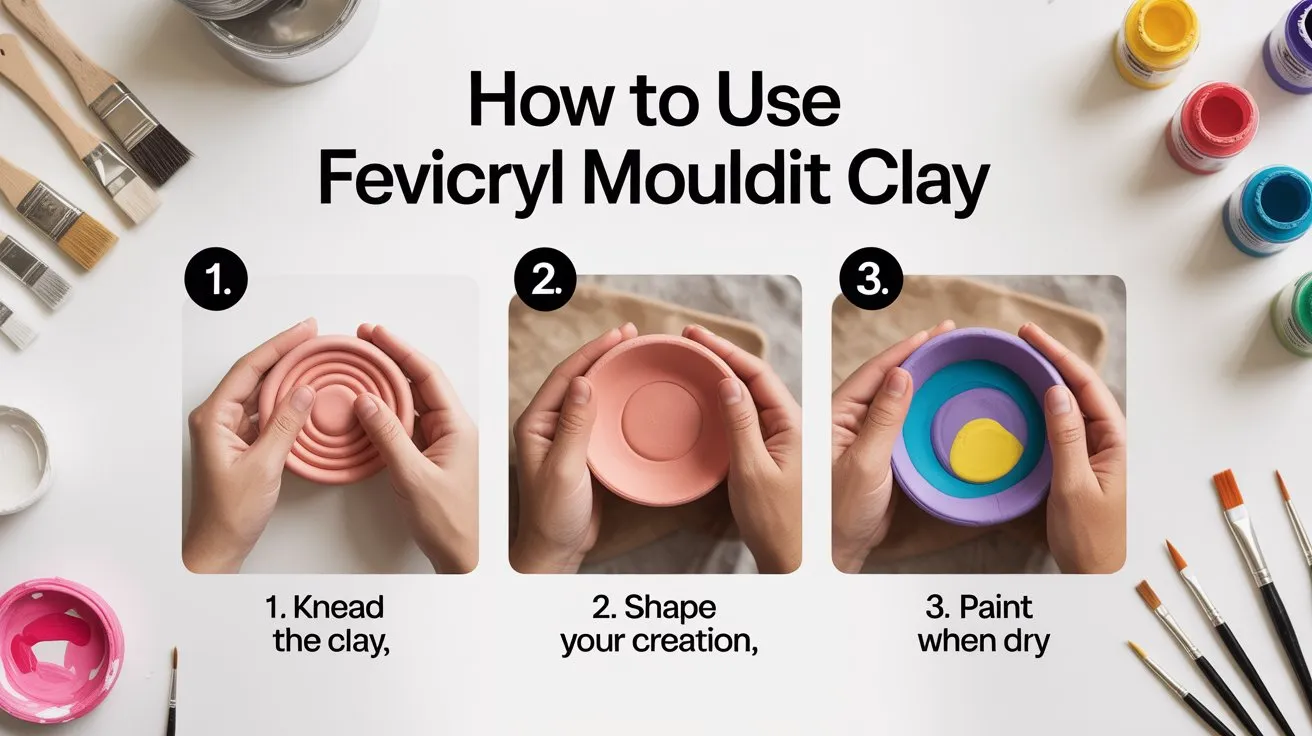
If you love DIY crafts or you’re just starting, Fevicryl Mouldit Clay is one of the easiest materials to work with in India. I’ve used it for small figurines, nameplates, fridge magnets, and even jewellery bases—and the best part is you don’t need a kiln or oven. In this guide, I’ll walk you through exactly how to use Fevicryl Mouldit clay, step by step, with tips that save time and prevent cracks.
Fevicryl Mouldit is a two-part epoxy modelling clay:
Part A (Resin)
Part B (Hardener)
When mixed in equal amounts, the clay becomes soft and workable. After curing, it turns rock-hard, durable, and paint-ready—ideal for Indian weather and home craft setups.
Fevicryl Mouldit (Part A & B)
A clean work surface (tile or plastic sheet)
A little water or petroleum jelly
Toothpicks or simple sculpting tools
Acrylic paints (after drying)
Clear varnish (optional, for shine & protection)
Always take equal amounts of Part A and Part B.
Tip: Roll both into the same-size balls before mixing—this avoids curing problems.
Knead both parts together using your fingers until the colour becomes uniform with no streaks.
This takes about 2–3 minutes. If it feels sticky, lightly wet your fingers.
Once mixed, you have 60–90 minutes of working time.
Roll, pinch, press, or mould as needed
Add textures using toothpicks or tools
Join parts by lightly wetting the surface
For fine details:
Work slowly
Keep fingers slightly moist
Support thin parts so they don’t droop
Place your piece in a dust-free area.
Initial set: 3–4 hours
Complete curing: 24 hours
Do not use a fan, sunlight, or heat to speed up drying.
Once fully cured:
Lightly sand rough edges
Paint with Fevicryl acrylic colours
Use thin layers for the best finish
Apply a clear varnish to:
Add shine or matte finish
Protect from dust and moisture
Increase durability (useful in the Indian climate)
Always mix with clean hands
Avoid touching your eyes while working
Wash your hands properly after use
Keep away from very young children
Do not ingest or use for food items
Unequal mixing of Part A & B
Overworking after it starts hardening
Drying under direct sunlight
Painting before full curing
I made these mistakes early on—and trust me, fixing cracks later is harder than doing it right the first time.
Home nameplates
Ganesh idols (small décor pieces)
Earrings & pendants
Keychains & fridge magnets
Mini planters & desk décor
School project models
It sets in 3–4 hours and cures completely in 24 hours.
Yes, it’s beginner-friendly and doesn’t require special tools.
No. It is air-dry epoxy clay—do not bake.
After curing and sealing, it becomes water-resistant, not fully waterproof.
Learning how to use Fevicryl Mouldit clay opens up endless DIY possibilities. Whether you’re a student, hobby crafter, or someone just exploring creativity at home, this clay is reliable, strong, and easy to master. Start small, be patient with drying, and enjoy the process—your hands will learn faster than you think.

Leave a comment